THE NEUROSCIENCE OF SLEEP
The Brain
You're not "off" when you're asleep — your brain is just running a completely different show. Every night, it cycles through distinct stages, each with its own brain wave patterns, its own job, and its own relationship to dreaming. This is where we get into what's actually happening up there while you're out cold.
Dive Deeper
THE ARCHITECTURE OF NIGHT
The Sleep Cycle
N1
Light Sleep
5-10% of night
This is the lightest stage of sleep, and honestly, you barely notice that it’s happening. It only lasts a few minutes as you drift from wakefulness into sleep [7]. Your brain waves start to slow down, but you’re still easy to wake up. Any random noise or twitch can pull you right back to full consciousness.
N1
Core Sleep
40-50% of night
This is the stage where your body starts to fully power down. Your temperature drops, your muscles relax, and your heart rate and breathing slow [7]. N2 makes up about half of your total sleep time, and your brain produces quick little bursts of activity called sleep spindles, which researchers think help protect your sleep from being disrupted by
outside noise.
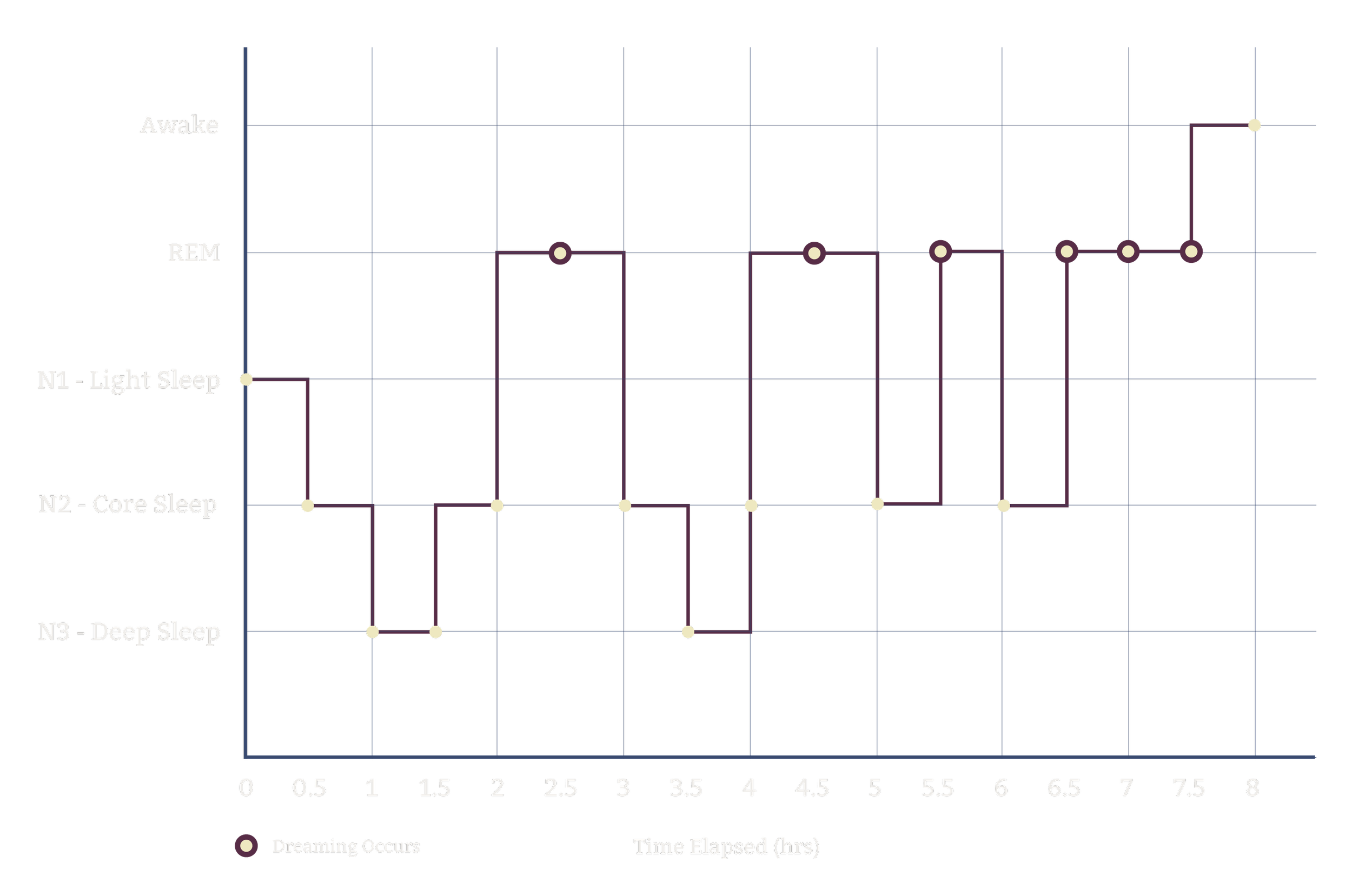
Here’s the interesting thing about sleep: it's not one long, uniform blackout. Throughout the night, your brain moves through a repeating cycle of distinct stages, and each one has its own unique personality. These stages are made up of different brain wave patterns, different jobs, and different relationships to dreaming.
A full sleep cycle takes about 90 minutes, and you’ll run through four to six of them in a typical 8-hour night [7]. But here's the twist, not every sleep cycle looks the same. Earlier in the night, your body prioritizes deep, restorative sleep. By the early morning hours, it shifts gears and gives you longer and longer stretches of REM. This is exactly why your most vivid, memorable dreams tend to happen right before your alarm goes off [7].
There are four stages total: three non-REM stages (N1, N2, N3) and REM sleep itself. Here’s a breakdown of what's actually happening in your brain throughout the night.
N3
Deep Sleep
15-25% of night
Also called slow-wave sleep, this is the hardest stage to wake up from. Your brain shifts into slow, high-amplitude delta waves, and this is where your body does its heavy-duty repair work: muscle recovery, immune support, and physical restoration [1][7]. You spend most of your deep sleep during the first half of the night, and it's a big part of why an interrupted early night can leave you feeling so physically wrecked the next day.
REM
Dreaming Sleep
20-25% of night
REM sleep is the strange one: your brain activity jumps back to near-waking levels, your eyes dart around behind closed lids, and your body goes essentially paralyzed except for your eyes and breathing muscles [1][6][7]. It's the stage most tied to dreaming where the brain is active enough to build a vivid, narrative world, even while you're totally disconnected from reality around you [5][6]. Your first REM stage might last only a few minutes, but by later cycles, it can stretch to nearly an hour [7].
ON AVERAGE, PER NIGHT
Time in Each Stage
N1 - Light Sleep
N2 - Core Sleep
N3 - Deep Sleep
REM - Dreaming Sleep
5%
50%
20%
25%
Myth vs. Fact
Hover to Reveal
Myth
All dreaming happens during REM sleep.
Fact
Not even close. While REM sleep produces your most vivid, story-driven dreams, your brain doesn't just shut off during the other stages [3]. Dreams also show up during NREM sleep, they're just usually shorter, more fragmented, and less bizarre than their REM counterparts [3][5]. Researchers have found that dream-like experiences can happen in almost any sleep stage, which means that a restorative stage like N2, isn't as dream-free as it looks [5].
Myth
You only dream once per night.
Fact
You're actually dreaming a lot more than you remember, except most of it just doesn't survive the trip to morning. Unless you wake up during or right after a dream, your brain tends to let that memory slip away almost immediately, even if it was vivid or emotional [5]. That's why people who wake up naturally, without an alarm, often recall fewer dreams than people who get jolted awake mid-dream. It's not that they dreamed less, it's that the memory never got the chance to stick [5].
KNOW THE FACTS
THE SLEEPING MIND
Brain Waves
Delta Waves (4 Hz)
Deep Sleep
The slowest, heaviest, highest-amplitude waves your brain produces [5]. Delta is the hallmark of N3, deep sleep, and it's exactly why that stage is so hard to wake up from. Even though the EEG looks almost quiet compared to an active, waking brain, this is when your body is doing its most important physical repair work [1][7].
Theta Waves (4-7 Hz)
Light Sleep
Theta takes over as you drift into N1, that brief on-ramp stage of sleep [5]. But theta doesn't just show up at the start of the night. It's also tied to dreaming itself. Researchers have found that people who show more theta activity in the frontal lobes during sleep are significantly more likely to remember their dreams the next morning, since that same frontal theta pattern is what your brain uses to encode and retrieve memories while you're awake [1]. Theta also reappears during REM sleep, layered underneath REM's faster, more awake-like activity [5][6].
Alpha Waves (8-12 Hz)
Wind Down
Alpha shows up when you're relaxed but still technically awake, where your eyes are closed, your mind is calm, and you’re right on the edge of sleep. It's the transition zone between full wakefulness and actually falling asleep, and it blends into theta almost seamlessly.
Beta Waves (13-30 Hz)
Wide Awake
Beta waves are fast, low-amplitude, and a little chaotic-looking on an EEG. They're the signature of an alert, thinking brain. It’s the kind of activity you'd see while you're reading this sentence right now. As you start to wind down for the night, beta waves are the first thing to fade.
Gamma Waves (Over 30 Hz)
Peak Focus
The fastest brain waves of all, associated with intense focus, high-level processing, and moments of peak alertness while awake. Gamma activity drops off sharply once you fall asleep, though researchers are still exploring exactly what role, if any, it plays inside dreaming itself.