VARIETIES OF THE NIGHT
Dreaming Types
Not every dream plays by the same rules. Sometimes your mind becomes aware that its dreaming. Sometimes your body wakes up before your brain does. Welcome to the weird middle ground of sleep.
TWO SIDES OF REM AWARENESS
Lucid Dreaming
Lucid dreaming is the phenomenon that happens when you realize you’re dreaming while it’s still happening. Normally, during sleep your brain switches off its ability to think critically about what it’s experiencing while you sleep, which is why you don’t question flying or talking to your childhood pet [9]. In a lucid dream, that critical thinking suddenly flips back on, and you become aware you’re inside a dream. In some cases, you even gain the ability to influence what happens next inside your dream [9].
Awareness
Control
Emotion
Sleep Stage
Brain Activity
Frequency
Fully aware you’re dreaming, in real time [9]
Often can influence or direct the dream [9]
Ranges from excitement, to curiosity, to calm [9]
Occurs during REM sleep [9]
Frontal cortex reactivates = self-awareness [9][11]
1 in 1,000 people experience it regularly [9]
Lucid dreaming occurs during REM sleep, but with a twist: your brain’s ability to reflect on its own thoughts, something that normally would shut off completely while you sleep, flips back on mid-dream [9]. EEG studies show that lucid dreaming produces a spike in gamma wave activity (the highest frequency of brain waves), especially in the frontal part of the brain. This frequency is typically higher than what shows up during regular REM sleep [9][11]. The only fMRI ever captured of someone actively lucid dreaming showed activation in brain regions that are usually quiet during REM, including the prefrontal cortex and precuneus. The frontal region of your brain that lights up during this is closely tied to self-awareness and reflective thinking while you're awake, which is likely why lucid dreamers can suddenly recognize “wait, this is a dream.” Brain connectivity during lucid dreaming also looks strikingly similar to being awake. Brain patterns are far more coordinated than a typical dream state, which is why scientists describe it as a genuine hybrid state, somewhere between sleeping and waking, rather than fully being either one [11].
Sleep Paralysis
Sleep Paralysis is what happens when your brain suddenly wakes up before your body does. During REM sleep, your muscles go temporarily limp (borderline paralyzed), so that you can’t physically act out your dreams. But every so often, that paralysis lingers for a few seconds (or minutes) after you’ve become conscious. You’re aware and awake, but stuck. And oftentimes, you experience vivid hallucinations at the same time.
Awareness
Control
Emotion
Sleep Stage
Brain Activity
Frequency
Aware you’re awake, but dream-like sensations [10]
No control, body remains physically frozen [10]
Usually fear, panic, or a sense of dread [10]
Occurs at the REM-to-wake transition [10]
Brain is awake, body is in paralyzed state [10]
7.6% of people experience it at least once [10]
Sleep paralysis sits right at the intersection of two systems that are usually perfectly in sync: your brain’s wake-up signal and your body’s paralysis switch. During REM sleep, the brainstem actively suppresses motor neurons to keep you from acting out your dreams. This is a state called atonia, which typically lifts the instance you regain consciousness [10]. In sleep paralysis, this switchover misfires, and researchers have identified several factors that make this misfire more likely. This includes hypertension, sleep deprivation, irregular sleep schedules, and genetic predisposition [10]. Once this happens, the experience isn’t just physical stillness. EEG records taken during sleep paralysis fall somewhere between full wakefulness and REM sleep. This might explain why these episodes feel neither fully like a dream or being awake [10]. This sensation is also commonly accompanied by hallucinations that are actually less random than they seem. Researchers have classified them into three consistent categories: a sensed intruder, pressure on the chest, or out-of-body sensations. These suggest a shared underlying neurological cause rather than pure imagination.
THE DARK SIDE OF DREAMING
Nightmares
A nightmare is more than just a bad dream. Clinically speaking, its a dream disturbing enough to wake you up, usually leaving behind a lingering sense of fear or dread [12]. They’re most commonly occurring during REM sleep, when the brain is at its most emotionally active, and they affect a huge range of people. Somewhere between 2-6% of adults deal with nightmares weekly [12][13]. Nightmares aren’t random misfirings either. Researchers believe they happen when the brain’s normal process for defusing fear during sleep breaks down partway through [13].
Under normal circumstances, dreaming works a little bit like nightly exposure therapy. Your brain pulls up a fear-related memory, strips away its original context, and re-pairs it with a less threatening scenario. In this way, your brain is gradually “extinguishing” the fear response to a real life scenario [13]. A nightmare happens when that process starts, but doesn’t completely finish, or sometimes never gets going in the first place [13].
ANATOMY OF A NIGHTMARE
The Dream Team
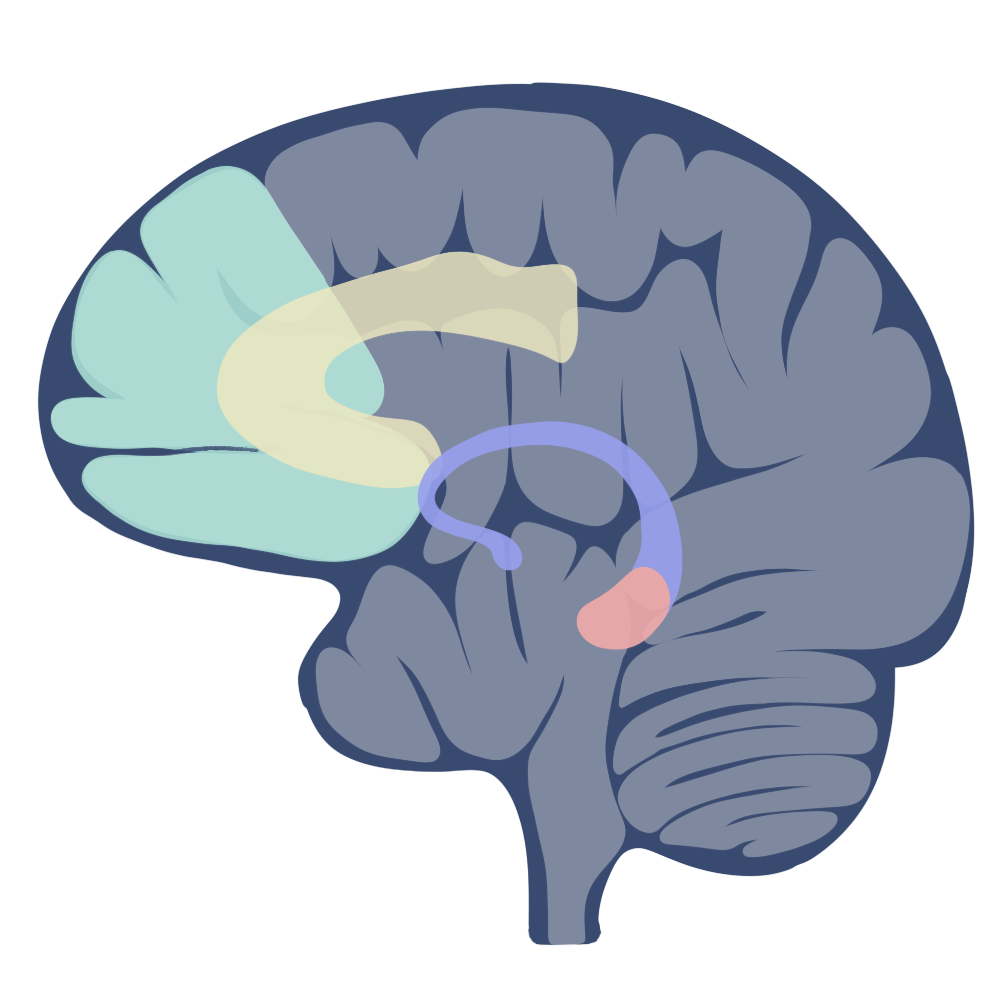
Four brain regions are responsible for what happens when you dream something scary. Researchers nicknamed this network AMPHAC. Basically, think of it as a four-person crew working the nightshift up inside your brain while you sleep. On a good night, this crew works together seamlessly. But on nights where you experience nightmares, the process stalls out somewhere along the way.
The Amygdala
The Alarm System
Fires off the fear response the second something threatening
shows up in a dream.
The Hippocampus
The Set Designer
Builds the context and scenery around the fear: where you are, who's there, what’s happening.
The Medial Prefrontal Cortex
The Filing Cabinet
Stores the “lesson learned” once fear has been successfully softened and re-filed as less threatening.
The Anterior Cingulate Cortex
The Emotional Thermostat
Regulates how much distress you actually feel while
its happening.
01
WHEN IT WORKS, WHEN IT DOESN’T
The Overnight Repair Job
Think of a normal dream as informal therapy your brain runs on itself every night.
Here's the three-step process [13]:
Pull the File
Your brain activates a fear-related memory
or association.
02
Rewrite the Scene
That fear gets stripped of its real-world context,
and rebuilt into a less threatening dream scenario.
Mildly disturbing image
You stay asleep through it
Full nightmare plays out
More distress during sleep
03
File as Resolved
A calmer emotional response gets attached to the memory, and the fear has officially been "softened."
The Nightmare Paradox
Here's the twist researchers weren't expecting: the scarier the dream image, the less likely you are to actually experience the full nightmare [12].
vs.
Intensely disturbing image
You wake up early
Nightmare gets cut short
More anxiety after waking up